
How Animals Can Support Mental Health and Trauma Recovery
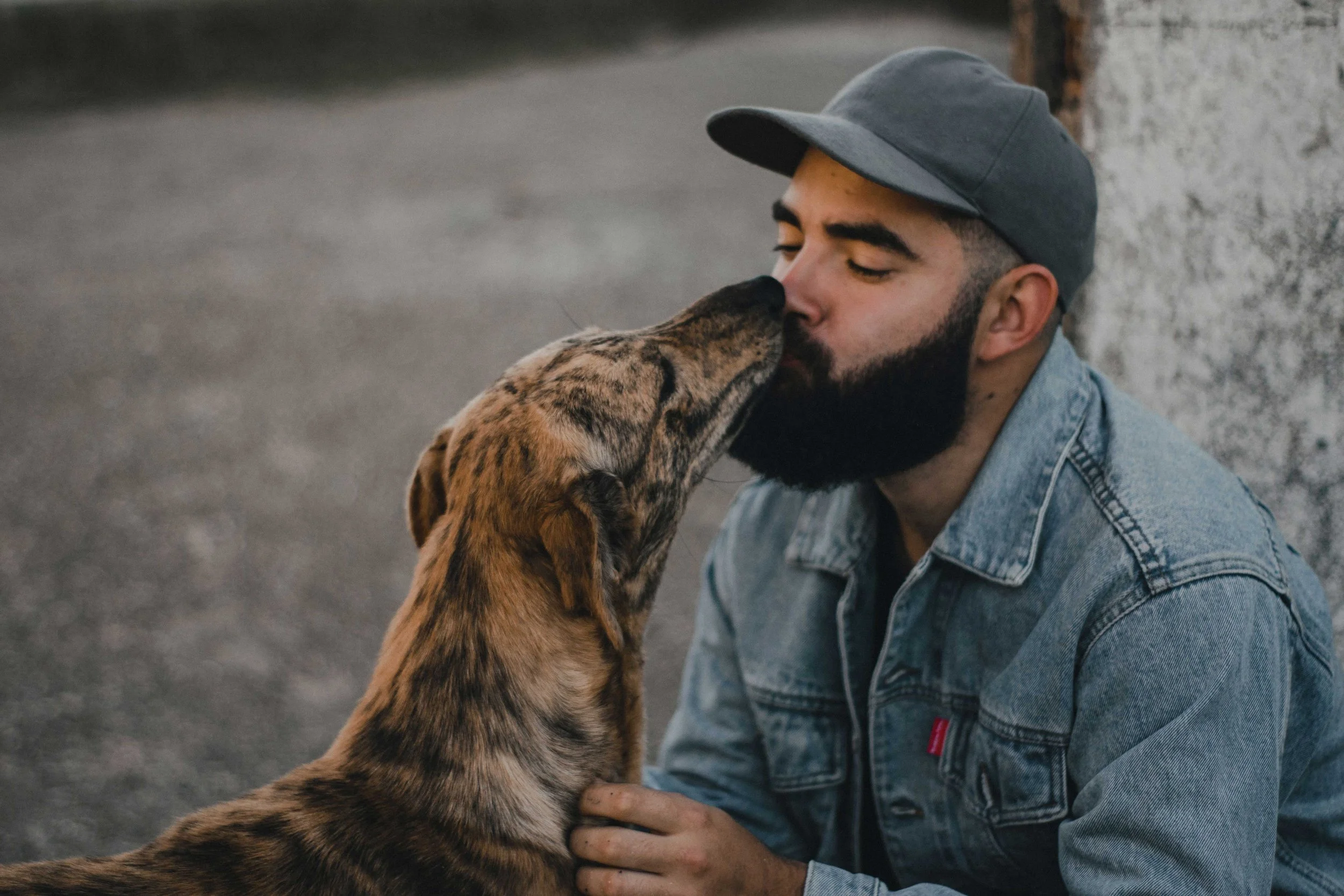
The bond we share with our animals can become one of the most comforting and consistent relationships in our lives.
For those of us who have experienced childhood trauma or deep relationship wounds, trusting people on a deeper level can feel complicated. Human relationships may have taught us to expect unpredictability, rejection, criticism, or harm. Animals can sometimes offer a very different experience of connection.
Trauma researchers are increasingly recognizing that companion animals can become secure attachment figures in a person’s life. When human relationships have felt unpredictable or unsafe, an animal may become a steady source of comfort, routine, affection, and emotional connection.
That doesn’t mean animals are automatically “safer” than people, or that they can replace supportive human relationships. But for many trauma survivors, the human-animal bond can become an important part of how they experience trust, co-regulation, connection, and care.
In this post, we’re going to look at how animals of all kinds can support mental health and trauma recovery, especially for people living with relational or childhood trauma. We’ll also look at when animal companionship may not be supportive, because there is no one-size-fits-all answer when it comes to healing.
Key Takeaways, TLDR;
Relationships with animals can offer trauma survivors experiences of consistency, connection, comfort, and companionship.
Animal companions can sometimes become a source of co-regulation, with their presence, movement, warmth, and physical closeness helping us settle when our nervous systems are activated.
For people who have experienced relational trauma, animals may provide opportunities to experience trust, boundaries, caregiving, and connection differently.
Interacting with animals can also provide sensory grounding, helping bring attention back to the body and what’s happening in the present moment.
Animals don’t heal trauma on their own, and they aren’t replacements for supportive human relationships or therapy. They can, however, become one meaningful relationship within a much larger process of healing.
Trauma Can Change the Way We Experience Relationships
When we talk about trauma, we often focus solely on what took place. But some of trauma’s longest-lasting effects can show up in what happens afterward, particularly in our relationships.
If the people you depended on were unpredictable, emotionally unavailable, frightening, controlling, neglectful, or abusive, your brain learned from those experiences. You may have learned that getting close to someone means getting hurt, feeling unsafe, expressing a need leads to rejection, or carefully monitoring someone else’s mood is necessary to figure out what’s coming next.
Those lessons don’t automatically disappear as you age and circumstances change. The brain and body have already learned how relationships work based on the lived experiences you’ve had.
As an adult, you might desperately want connection while simultaneously feeling anxious when someone gets too close. You may struggle to ask for what you need, expect rejection, overanalyze subtle changes in someone’s behavior, shut down during conflict, or feel responsible for keeping everyone around you happy.
This is one reason trauma therapy is often relational. Healing isn’t only about intellectually understanding what happened. For many people, part of the work involves having new experiences of connection, boundaries, trust, repair, and being known without being harmed.
Human relationships are an important part of that process, but they aren’t necessarily the only relationships that can support that.
Animals Can Offer Connection Without Requiring So Much From Us
Relationships with people can be complicated to say the least. We have histories, expectations, misunderstandings, social rules, conflict, insecurities, and approximately eight million opportunities to wonder whether someone’s text sounded weird.
Relationships with animals are complicated in their own ways, but the social demands can be very different.
An animal doesn’t need you to find the right words for what you’re feeling. You don’t necessarily have to explain why you’re quiet, make conversation, or pretend you’re having a better day than you are. Sometimes you can simply exist together.
For someone whose nervous system has learned to closely monitor other people, that can feel very different from human connection. Animal companionship can offer another kind of relational experience, one where closeness may feel less socially demanding and you don’t have to perform in order to participate.
This doesn’t mean animals are inherently safer than people, and the goal of trauma recovery isn’t to replace relationships with humans with relationships with animals. But for some trauma survivors, having access to a relationship that asks something different of them can be pretty significant.
Animals Can Become a Source of Co-Regulation
Humans develop the capacity for regulation in relationship with other people. A calm voice, reassuring presence, facial expression, physical closeness, or familiar routine can all influence how our bodies respond when we’re overwhelmed. This process is often referred to as co-regulation.
Ideally, we experience plenty of it while we’re growing up. A child becomes frightened, upset, or overwhelmed, and a caregiver helps them settle. Across thousands of these interactions, the child gradually develops a greater capacity to recognize and manage their own internal states.
However, If your caregivers were emotionally unavailable, unpredictable, frightening, overwhelmed themselves, or simply didn’t know how to respond to emotions, your nervous system may have had fewer opportunities to learn what it feels like to become overwhelmed and then be supported back toward regulation.
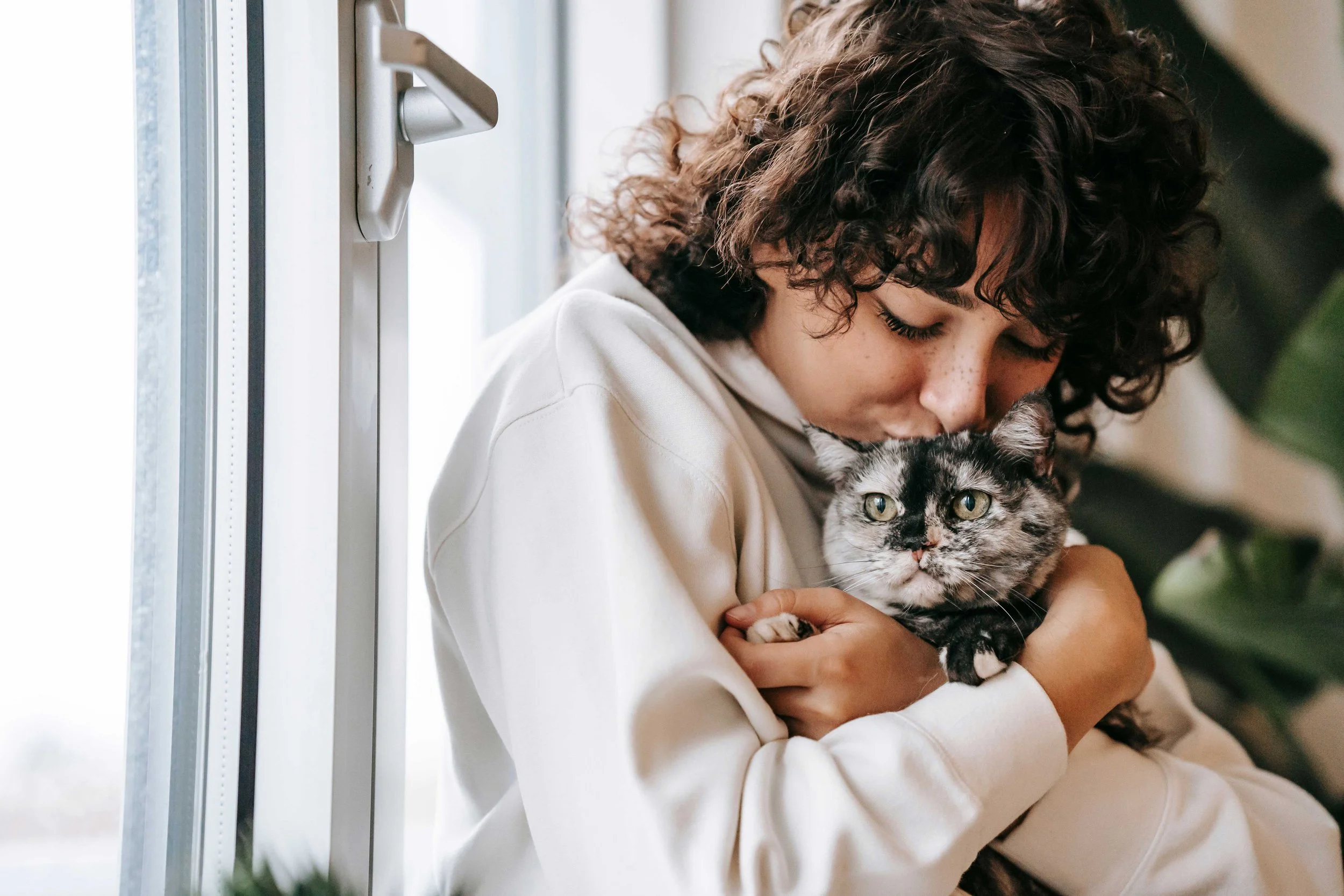
Animal companions can sometimes become another source of co-regulation.
Research on human-animal interaction suggests that positive interactions with animals, particularly dogs, may affect physiological systems involved in stress and social bonding, including cortisol, oxytocin, heart rate, and heart rate variability.
The findings aren’t perfectly consistent, and being near an animal isn’t a biological reset button, but there is evidence that our bodies can respond to these interactions.
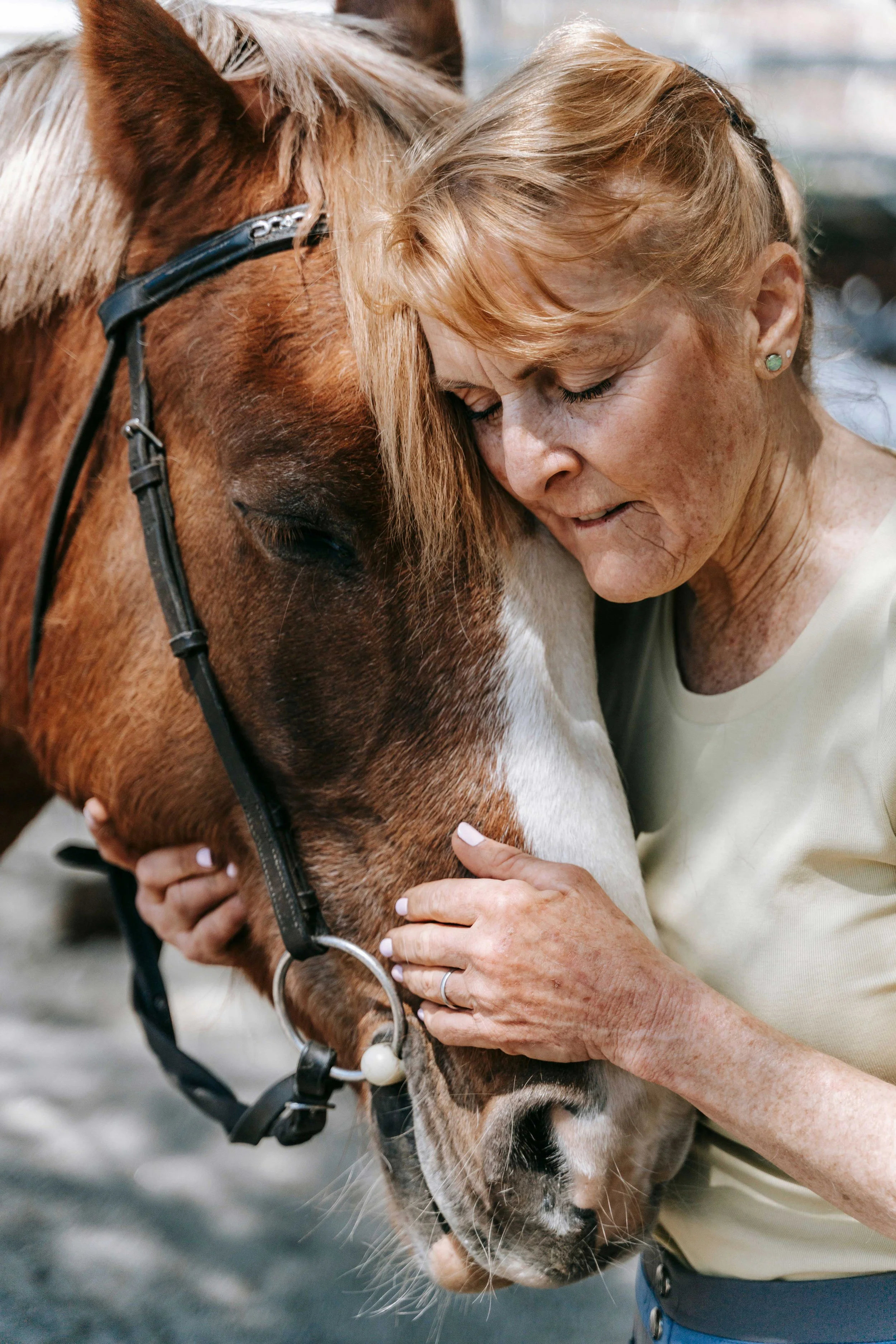
You may recognize the experience without knowing anything about the physiology behind it. Maybe your dog leans against your legs while you’re anxious and you notice yourself beginning to settle. Maybe your cat curls up on your chest and the warmth, pressure, and vibration of their purring gives your attention somewhere concrete to land. Maybe grooming a horse requires you to slow down and pay attention to what’s happening directly in front of you.
The distress hasn’t disappeared. Instead, your nervous system is receiving additional information alongside it: warmth, pressure, rhythm, familiarity, movement, and connection.
Sometimes being alongside another living being who feels familiar and settled can help our own bodies find their way toward settling, too.
Animals Can Help Us Come Back to the Present
Trauma has a way of pulling us out of the present. Sometimes that’s obvious, like experiencing an intrusive memory or flashback.
Other times it looks like constantly scanning the environment for what could go wrong, mentally rehearsing every possible outcome, or feeling disconnected from your body and surroundings.
Your brain may understand that something happened years ago while your body responds as though the danger is happening right now. One part of trauma recovery involves helping the brain and body differentiate between then and now.
Grounding can help with that, and animals happen to provide a lot of sensory information.
You can feel fur underneath your hand, notice the weight of an animal resting against you, listen to the rhythm of their breathing, feel a cat purring against your chest, or notice the repetitive movement involved in grooming a horse. Walking a dog can bring your attention toward your feet against the ground, the temperature outside, sounds around you, and whatever fascinating smell has apparently brought your dog to a complete halt.
Those sensations provide concrete information about what’s happening in your current environment. An animal’s familiar presence can become part of that orientation, giving your attention somewhere in the present to land.
Animals aren’t determining whether we’re objectively safe. Anyone who has watched a dog lose their mind over a cardboard box knows they aren’t infallible threat-detection systems.
But their familiar presence can become one of many cues that helps us reconnect with where we actually are.
Animals Can Give Us Experiences of Consistency
Trauma often involves a lot of unpredictability. Maybe you didn’t know which version of someone you were going to get from moment to moment.
Affection might have been available one day and withdrawn the next. Or conflict appeared without warning and someone else’s mood determined whether the house felt calm or dangerous.
When relationships have been unpredictable, consistency can become incredibly meaningful.
Animals often create routine simply by existing in our lives. Breakfast happens. Walks happen. Water bowls need filling. Horses need feeding. Litter boxes remain tragically unwilling to clean themselves.
These routines aren’t particularly glamorous, but predictability can be regulating and the consistency of a routine can relief stress.
Relationships with individual animals also develop their own patterns. Your cat appears when you make coffee. Your dog sleeps in the same place beside you. Your horse greets you in a familiar way. Your animal waits by the door when you come home.
Tiny experiences of consistency accumulate over time. For someone whose nervous system became accustomed to constantly anticipating what might change, knowing what comes next can provide a meaningful sense of stability.
Animals Can Give Us Opportunities to Practice Trust
People sometimes talk about trust as though it’s a decision: You just have to learn to trust again.
But trust usually isn’t something we can reason ourselves into. It’s learned through experience.
Someone says they’ll show up, and they do. You express a need, and you’re not punished for having it. You set a boundary, and the relationship survives. Something goes wrong, and there’s repair afterward. Over time, those experiences provide evidence that relationships don’t always have to work the way they once did.
Relationships with animals can offer their own versions of this.
You learn your animal’s cues, and they learn yours. You discover what they enjoy and what makes them uncomfortable. You begin recognizing when they want closeness and when they need space. They begin anticipating your routines and recognizing your patterns.
Neither of you understands the other perfectly. Cross-species communication does come with a few limitations. But you’re continually learning how to attune to one another and understand each other.
Trust develops through hundreds of ordinary interactions rather than one dramatic moment. For someone who has experienced relational trauma, that gradual process can be meaningful. It gives us another opportunity to experience the fact that trust can be built rather than demanded.
Animals Can Teach Us About Boundaries and Consent
One of my favorite things about working with and living alongside animals is how much they can teach us about boundaries.
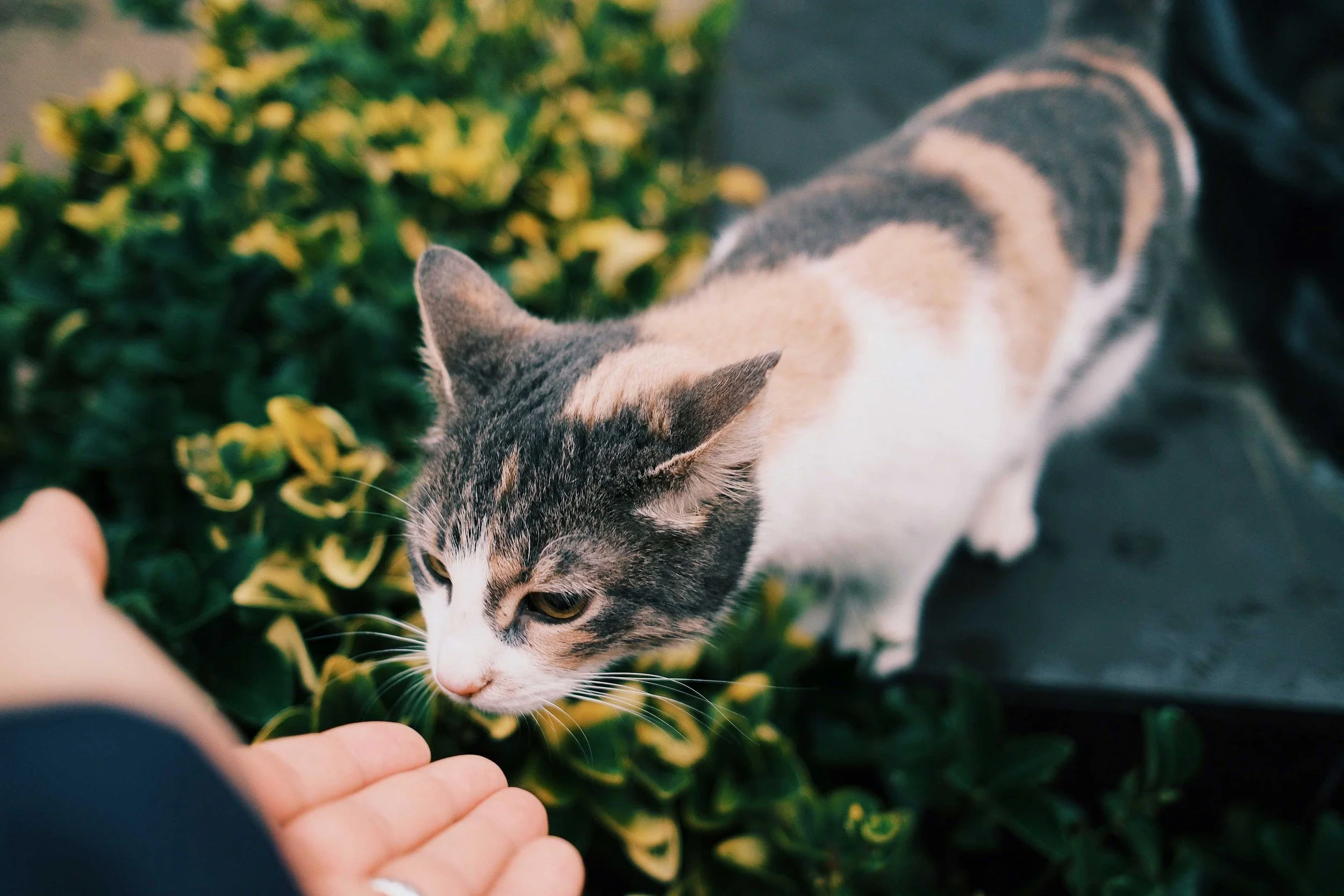
Every animal has preferences. Some want to be physically attached to you at all times, others enjoy affection for thirty seconds and then would like you to kindly remove your hand.
Developing a respectful relationship with an animal requires paying attention.
What does their body language tell you? Are they moving closer or farther away? Are they relaxed or tense? Do they want interaction right now? What happens when they communicate that they’ve had enough?
Healthy relationships require us to recognize that another being can have needs, preferences, and limits that are different from ours.
For trauma survivors, boundaries can be particularly complicated. Maybe saying no wasn’t allowed. Maybe other people’s needs always came before yours. Maybe affection was demanded rather than freely given, or someone’s reaction to a boundary taught you that saying no could cost you the relationship.
Relationships with animals can sometimes provide small opportunities to practice something different. You can respect an animal’s “no” without interpreting it as rejection. You can allow them to move away without chasing connection. You can learn that they may come back when they’re ready and that closeness doesn’t require constant access to one another.
Over time, those experiences can reinforce an important lesson: boundaries don’t have to end relationships. Healthy boundaries can actually help relationships feel safer.
Caring for an Animal Can Change the Way We Think About Care
Trauma can affect our relationship with caregiving, too. Some people become extremely comfortable taking care of everyone except themselves. Others learn that needing care is shameful, weak, inconvenient, or dangerous.
If your needs weren’t consistently responded to growing up, you may have learned to minimize them entirely.
Animals have a way of making the basic needs of living beings very obvious.
Your animal needs food even when they haven’t accomplished anything productive that day. They need rest without earning it first. They need medical attention when they’re hurting. They may need reassurance when they’re frightened, patience when they’re struggling, or additional support as they age.
Most of us don’t look at a sick animal and think, Wow, they’re being incredibly needy right now. We recognize that something is wrong and respond with care.
Sometimes it’s easier to extend that compassion outward before we’re able to extend it toward ourselves.
Caring for an animal doesn’t automatically teach self-compassion, but it can invite some interesting questions about the standards we apply to ourselves compared with the beings we love.
If rest, comfort, patience, and care are reasonable needs for them, why do those same needs sometimes feel so unacceptable when they’re ours?
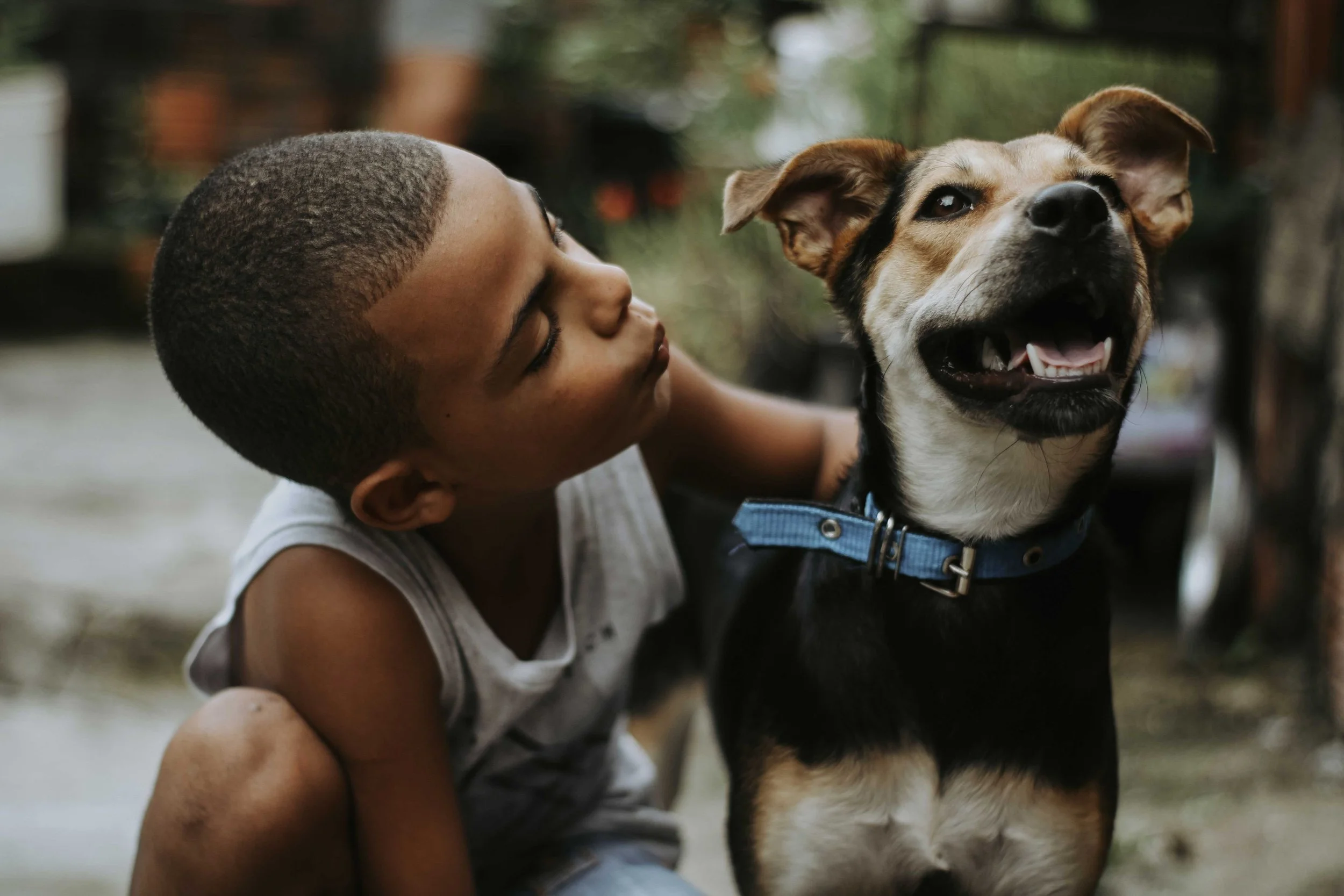
Animals Can Provide Comfort During Loneliness
Trauma can be incredibly isolating. Sometimes people withdraw because relationships can feel overwhelming. Shame will tell us that nobody would understand, you’re being a burden, and to go away and retreat inward until you’ve “fixed it”.
Sometimes the people we hoped would support us simply aren’t able to give us what we need.
Animal companionship doesn’t replace human connection, but it can change what being alone feels like.
There is another living being in the room. Someone waiting when you come home, following you into the kitchen, sleeping beside you, or sitting nearby while you’re having a difficult day.
Research on companion animals and loneliness suggests animals may provide meaningful social support for some people, although the findings vary and simply owning an animal doesn’t automatically protect someone from loneliness or other mental health struggles.
Still, relationships don’t have to fit one particular definition to matter.
For many of us, our animals become family. They become woven into our homes, schedules, memories, identities, and everyday lives.
And when a relationship becomes that significant, losing it can be devastating.
The Relationships That Comfort Us Can Also Break Our Hearts
Talking about the benefits of animal companionship without talking about grief leaves out a huge part of the picture.
Animals age and get sick and sometimes we’re faced with medical decisions that don’t have one obvious right answer.
For trauma survivors, caring for a senior or medically complex animal can also activate anxiety, hypervigilance, guilt, helplessness, or fear of loss. You may find yourself monitoring every change in behavior, wondering whether you’re doing enough, or trying to emotionally prepare yourself for a loss you can’t actually prepare for.
And the truth is, eventually, we lose them.
Pet loss can be profoundly painful precisely because the relationship was meaningful. If an animal has been a source of companionship, routine, comfort, grounding, or co-regulation for years, you’re not only grieving someone you love. Your daily environment changes. Your routines change. The sounds in your home change. The places where your attention used to go throughout the day suddenly feel different.

Can Animals Help Heal Relationship Trauma?
I don’t think it’s accurate or helpful to say that animals can heal relational trauma by themselves.
But relationships with animals can give some trauma survivors opportunities to experience different relational evidence.
Like connection can exist without constant performance. Closeness can coexist with boundaries and care doesn’t always have to be earned. Someone can move away and come back. Trust can develop slowly.
Those experiences don’t automatically rewrite everything that came before. Human relationships still matter deeply, and healing relational trauma often involves developing healthier relationships with other people, including within the therapeutic relationship.
But healing rarely comes from one source.
Sometimes an animal companion becomes one relationship among many that helps us learn something new about what connection can feel like.
My Perspective as a Trauma Therapist and Service Dog User
My interest in the human-animal bond is both professional and personal.
I’m a trauma therapist, and I work alongside a therapy dog named Mama, who can be incorporated into sessions when it’s clinically appropriate and something a client wants.
I’m also a service dog user myself, so I’ve experienced firsthand what it can mean for an animal to become part of how you navigate everyday life.
That perspective has shaped the way I think about trauma recovery. I’ve seen how animals can become sources of comfort, grounding, predictability, and connection, but also how meaningful the relationship itself can be.
In therapy, Mama isn’t there because dogs magically make trauma heal. Sometimes its just her presence that is simply comforting. Other times, an interaction with her can become part of the therapeutic work.
A client might notice what happens in their body when Mama approaches them, practice recognizing her body language, or explore what comes up when she chooses to move away and later returns.
Those moments can naturally open conversations about trust, rejection, boundaries, consent, attachment, caregiving, and connection.
And sometimes Mama is just there, quietly existing in the room while someone talks about something difficult.
Not every interaction needs to become a therapeutic metaphor. Sometimes the relationship itself is enough.

Animal Companionship Isn’t Right for Everyone
None of this means every trauma survivor needs an animal.
Animals require money, energy, time, veterinary care, appropriate housing, and the capacity to meet another living being’s needs. Behavioral challenges, illness, financial stress, caregiving responsibilities, and eventual loss can also significantly affect mental health.
For one person, living with an animal may be deeply supportive. For someone else, the responsibility may be overwhelming. Both experiences exist.
There are also people who simply don’t particularly enjoy being around animals. You do not need to acquire a cat in order to successfully recover from childhood trauma.
The goal isn’t to prescribe animals as trauma treatment. It’s to recognize that the relationships we form with them can be psychologically meaningful and, for some people, become part of a much larger network of relationships and experiences that support recovery.
Healing Happens in Relationship
Trauma can teach us powerful lessons about relationships: that closeness is dangerous, needs are burdensome, trust is risky, boundaries lead to rejection, or love has to be earned.
Those lessons make sense when we understand where they came from, but they don’t have to be the only relational experiences we ever have.
Over time, new experiences can give us new information. A therapist who respects your boundaries. A friend who stays after a difficult conversation. A partner who listens when you say no or a community where you don’t have to perform to belong.
And sometimes, an animal who has slowly learned your routines while you’ve slowly learned theirs.
No single relationship heals trauma. But relationships can give us opportunities to discover that connection can look different from what we’ve known before.
For some of us, animals are part of that story, too.

Frequently Asked Questions
Can animals help people heal from trauma?
Animals can provide comfort, consistency, grounding, companionship, and opportunities for connection that some trauma survivors find supportive. They don’t erase or treat trauma on their own, but relationships with animals can become one meaningful part of a person’s larger support system and recovery process.
What is co-regulation with an animal?
Co-regulation describes the ways our emotional and physiological states can be influenced through connection with another living being. For some people, sitting beside a relaxed animal, petting them, noticing their breathing, or experiencing their familiar physical presence can help their own body begin to settle during periods of stress.
This doesn’t mean an animal can automatically regulate another person’s nervous system. For some, being around animals is stressful or uncomfortable. Rather, familiar sensory and relational experiences can provide cues that some people experience as calming.
Why do trauma survivors sometimes feel more comfortable with animals than people?
For some trauma survivors, relationships with people have historically involved unpredictability, rejection, criticism, control, neglect, or harm. Animal companionship may feel less socially demanding and can provide connection without requiring conversation, explanation, or emotional performance.
The goal isn’t to replace human relationships with animals. Animal companionship can simply be one meaningful form of connection while someone also develops supportive relationships with people.
Can animals help with attachment wounds?
Relationships with animals can provide experiences of consistency, caregiving, boundaries, trust, and connection that may be meaningful for people with relational or attachment trauma. An animal relationship can’t replace the work of developing healthier human relationships, but it may provide additional relational experiences that challenge old beliefs about what connection has to look like.
What is animal-assisted or canine-integrated therapy?
Animal-assisted therapy intentionally incorporates an animal into therapeutic work to support specific treatment goals. Depending on the person and situation, this might involve exploring boundaries, attachment, trust, emotional regulation, communication, grounding, or simply having an animal present while discussing difficult material.
The animal’s needs and consent matter, too. Interaction should never be forced for either the client or the animal.
Final Thoughts
Trauma can change the way we experience trust, closeness, safety, and relationships. And while animals can't undo what happened or replace the human relationships we need, they can sometimes give us another way to experience connection.
Through thousands of ordinary moments, our animals can show us what consistency feels like. We learn each other's routines, communicate across species (with varying degrees of success), respect each other's boundaries, and build trust over time.
They can sit beside us when there aren't words for what we're feeling and give us something tangible to come back to when our minds are somewhere else.
I think that's part of what makes the human-animal bond so powerful. It isn't necessarily one big, life-changing moment. It's a relationship built through all of the tiny ones.
For trauma survivors especially, those experiences can become part of a much bigger process of discovering that connection doesn't always have to feel the way it did before.
Our animals can't heal our wounds for us. But they can walk alongside us while we do.